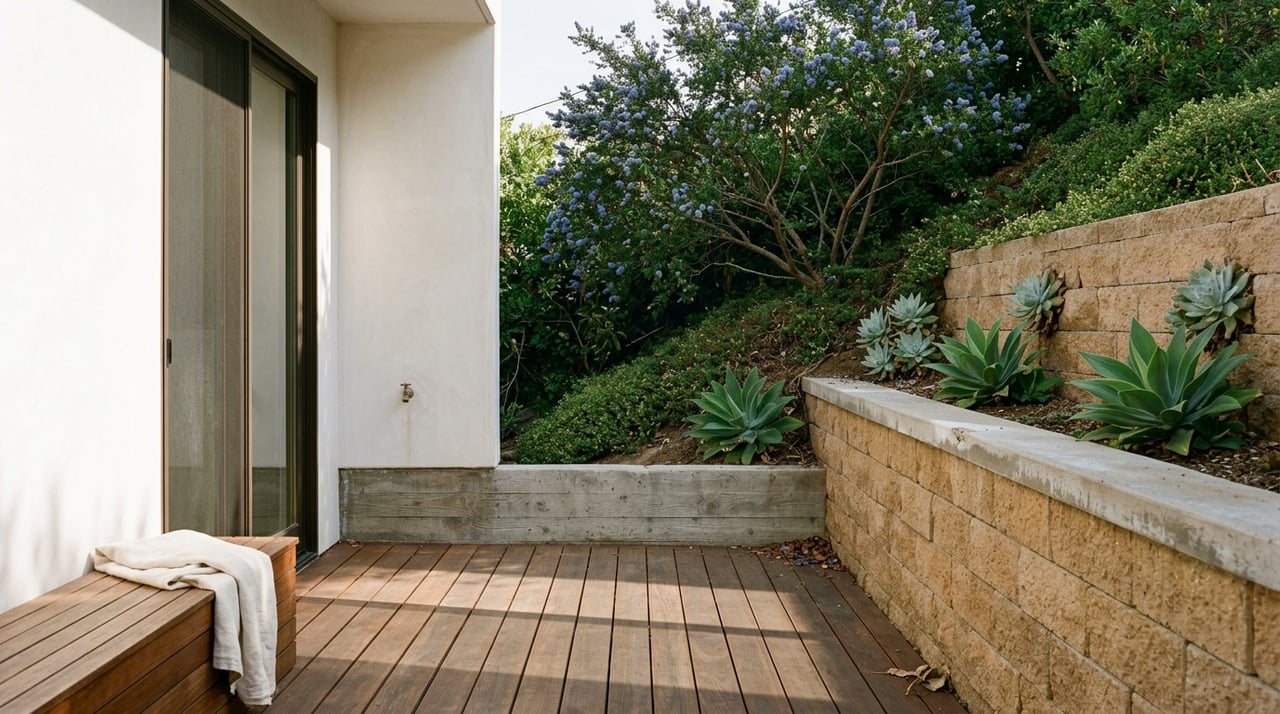
On A Laguna Beach Hillside, The Geotechnical Report And The Insurance Quote Are Racing The Same Clock
August 20, 2026
August 20, 2026
"There was a landslide right around Point Place down in between 9th and 10th Street Beach." That was Laguna Beach Fire's Battalion Chief Ian Da Costa, describing the radio call his department received at 7:59 a.m. on January 31, 2025. By the time crews arrived, roughly 500 cubic yards of bluff had already come down, taking the shared HOA stairway to the beach with it and closing 1000 Steps Beach to the public until the city's Building Department could assess what was left of the slope.
No house fell that morning. Three homes sitting directly above the failure were left standing, and a geologist was dispatched within hours to check whether they would stay that way. That distinction, between a slope that fails and a slope that merely reminds everyone it can, is the entire argument for why buying on a Laguna Beach hillside works differently than buying almost anywhere else in coastal Orange County. The risk isn't the headline. The pace at which you're required to respond to it is.
Laguna Beach's most studied slope failure isn't Point Place. It's Bluebird Canyon, which slid in June 1978, destroying more than 20 homes, and slid again in the same location in 2005, destroying 17 more. Geologists who mapped the 1978 event traced it to a dip slope of interbedded siltstone and sandstone that had been sitting in a state geologists describe as approaching a threshold for decades, moving in increments too small to notice until the accumulated shift gave way all at once.
The second slide came 27 years after the first, on ground that had been quietly rebuilt on in the interim. That's the detail that should reframe how a buyer reads a listing's silence on soil history. A parcel with no documented slide in the public record isn't necessarily a parcel with no slide risk. It may simply be a parcel whose slope hasn't reached its next threshold yet, which is precisely why the city's permitting system doesn't treat a clean history as a substitute for a current geotechnical opinion.
Laguna Beach's coastal zoning code sets its appeal jurisdiction to include all area within 300 feet of the top of the seaward face of any coastal bluff, which covers a meaningful share of the hillside and canyon-rim parcels the city is known for. Structural work inside that boundary triggers Coastal Development Permit review on top of standard building permits.
The city's own building permit process spells out what that review actually asks for. Once plans clear zoning and CEQA screening, staff flag any special studies required, including geotechnical, hydrology, or grading reports, and the construction submittal itself calls for two full sets of geotechnical soils reports alongside the architectural and structural drawings. The Design Review Board that signs off on hillside projects meets only twice a month, on the second and fourth Thursday, which is a scheduling detail that matters more than it sounds like the first time a buyer's renovation timeline runs into it.
Laguna Beach's planning department goes further than most coastal cities by giving this its own named category on the permit application list: Bluff Edge Determinations and Geotechnical Soils Reports sit as a distinct line item alongside historic assessment and habitat restoration submittals. That's not boilerplate. It's the city acknowledging that bluff geometry and soil behavior are specific enough problems to need their own paperwork track, separate from the general building permit.
None of this is unique to Laguna. Just down the coast in Dana Point, back-to-back atmospheric river storms in February 2024 reactivated a bluff on Scenic Drive, leaving three multimillion-dollar homes standing but under active monitoring while a civil engineer recommended tarping the bare soil and rerouting downspouts before the next storm hit. The pattern across south Orange County's coastal bluffs is consistent: wet winters wake up old ground, and the homes built on it inherit the geotechnical history of the slope whether the listing mentions it or not.
Here is the part that catches even well-prepared buyers off guard. A hillside purchase in Laguna Beach isn't running one due-diligence clock. It's running two, and they move at different speeds.
The first clock is the geotechnical letter of opinion, the buyer's-side report that reviews prior studies, walks the site, and tells you whether the slope under the house is behaving the way the seller's disclosures say it is. It moves on its own schedule, separate from the city's process, but the city's process is a useful reference point for how seriously Laguna Beach treats this ground. Structural engineers who work these hillside permits routinely describe standard plan review here running six to eight weeks, longer than most coastal cities, with Coastal Commission review adding another three to six months when a project falls under state jurisdiction. A buyer's letter of opinion moves faster than a full permit, but a bluff-front parcel or a home with prior remediation still means more paper trail to reconcile and, often, new borings before an engineer will sign off.
The second clock is insurance, and in 2026 it is no longer a formality you handle the week before closing. Most hillside parcels in Laguna Beach now place through the California FAIR Plan, the state's insurer of last resort, because standard carriers have pulled back from wildfire-adjacent coastal terrain across Orange County. The FAIR Plan itself covers fire, lightning, explosion, and smoke, nothing else, up to a $3 million dwelling limit, a cap the state raised from $1.5 million as rebuild costs climbed. Everything else, including the earth movement that actually causes hillside losses, has to come from a separate Difference in Conditions policy layered on top. For hillside and foothill Orange County homes, agents who place these policies regularly describe FAIR Plan premiums alone running $5,000 to $12,000 or more a year, with a companion DIC policy adding another $500 to $2,000 or more. The FAIR Plan itself filed an average 35.8 percent rate increase in October 2025, with many policyholders seeing 40 to 55 percent increases under the revised risk-based rating, which is one more reason a seller's old declarations page is a starting reference and not a number to bank on.
The two clocks rarely finish at the same pace, and that's the mechanism most guides to this market skip.
| Due-diligence item | What it involves | What can slow it down |
|---|---|---|
| Geotechnical letter of opinion | Reviews prior studies and site history, confirms current slope condition | Bluff-front parcels and homes with prior remediation often need new borings |
| FAIR Plan plus DIC insurance stack | FAIR Plan covers fire only, capped at $3M; DIC layers on everything else | Binding can take as little as 48 to 72 hours, or stretch well past a week with any complication |
That spread in binding time isn't a rounding error. An established independent agent working a straightforward hillside file has bound coverage in as little as 48 to 72 hours. A file with any complexity, a prior claim, deferred maintenance the carrier flags, a geotechnical review still pending, can stretch considerably longer. If your lender won't clear to close without a bound policy in hand, and your geotech letter comes back mid-contingency-period asking for one more boring before it signs off, you can find yourself asking for an extension on a house that has nothing wrong with it. The delay isn't the slope. It's the sequencing.
The buyers who move through this cleanly in Laguna Beach tend to do the same three things in the same order, starting the day escrow opens rather than after the inspection contingency clears.
Laguna Beach has no shortage of engineers who do this work daily. Firms like Rock Solid Geotechnical and SA Geotechnical are both based in the city and spend their working hours on exactly the kind of slope and soils questions this process raises, which is part of why local geotechnical review here tends to be more thorough, and slower, than in flatland markets.
Does every Laguna Beach hillside home need a Coastal Development Permit to sell? No. A CDP is triggered by new structural development or significant remodeling within the coastal zone, not by the sale itself. But if you're buying with renovation plans, or the home sits within 300 feet of a bluff edge, expect that permit track to shape your timeline before you break ground.
Can I rely on the seller's existing geotechnical report instead of ordering my own? You can review it, and it's a useful starting point, but a buyer's letter of opinion exists specifically to confirm the prior findings still hold and that nothing has shifted since the report was written. Given how slopes here have historically moved in small increments before a larger event, that confirmation step is worth the cost.
Is the California FAIR Plan the only option for a Laguna Beach hillside home? It's the most common placement for hillside parcels right now, but not universal. Some properties with newer construction, documented mitigation, or a clean claims history still qualify for standard market coverage. That's worth exploring with a broker experienced in coastal hillside placements before assuming FAIR Plan is your only path.
A hillside home in Laguna Beach rewards patience and punishes assumptions in roughly equal measure. The slope has been there longer than any of the paperwork written about it, and the city's own permitting language reflects that. If you're weighing a purchase on Bluebird Canyon, Temple Hills, or any of the city's canyon-rim streets, the smartest move isn't skipping the reports. It's starting both clocks on the same day.
If you're evaluating a specific hillside property in Laguna Beach and want a clear read on what its history and its paperwork actually say, Connie Maxsenti can walk you through it. Let's Connect — Schedule Your Free Consultation.
Stay up to date on the latest real estate trends.
Luxury real estate specialist. With years of experience and a track record of success, I am here to exceed your expectations. Contact me today to start your home searching journey!